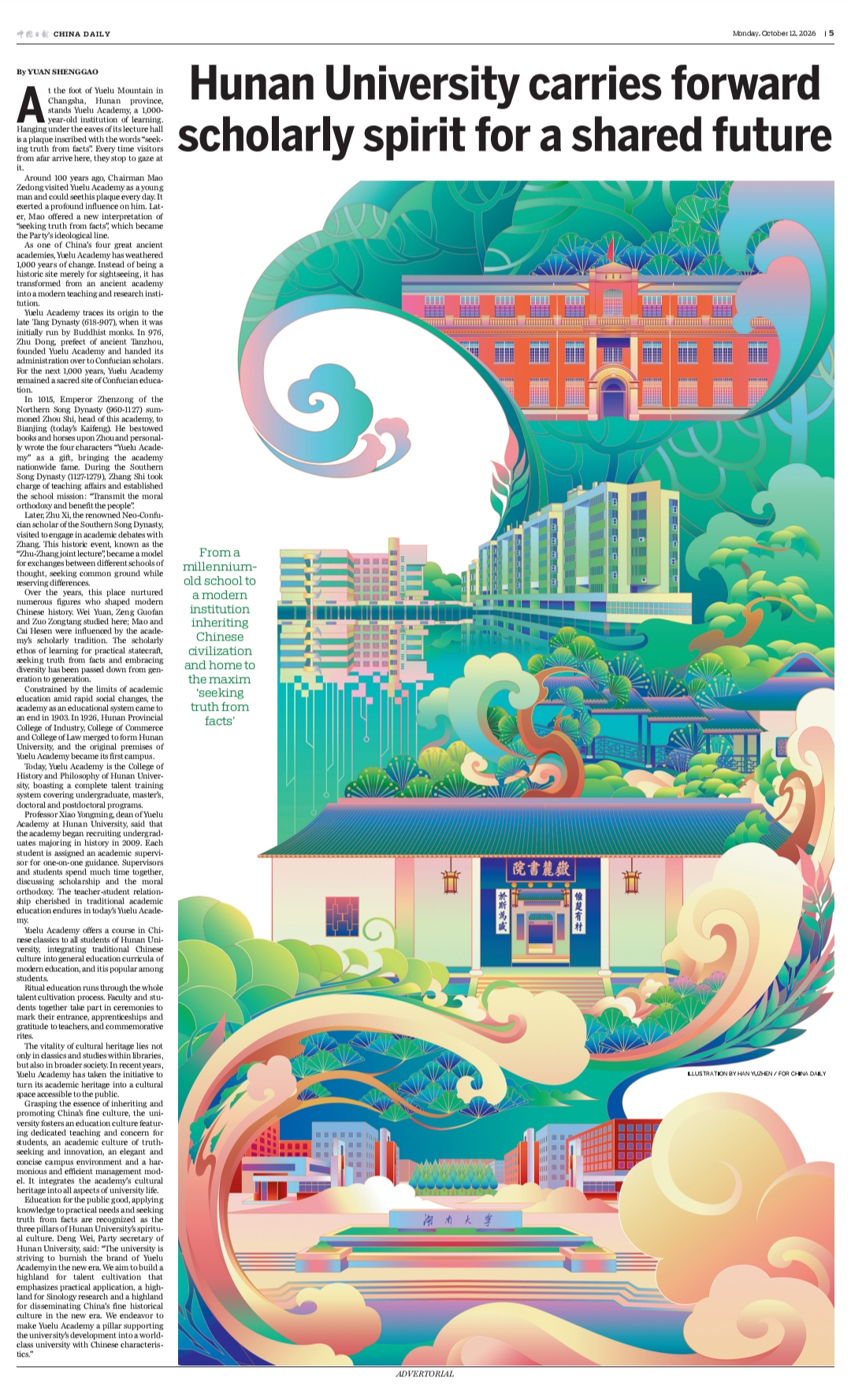
At the foot of Yuelu Mountain in Changsha, Hunan province, stands Yuelu Academy, a 1,000-year-old institution of learning. Hanging under the eaves of its lecture hall is a plaque inscribed with the words "seeking truth from facts". Every time visitors from afar arrive here, they stop to gaze at it.
Around 100 years ago, Chairman Mao Zedong visited Yuelu Academy as a young man and could see this plaque every day. It exerted a profound influence on him. Later, Mao offered a new interpretation of "seeking truth from facts", which became the Party's ideological line.
As one of China's four great ancient academies, Yuelu Academy has weathered 1,000 years of change. Instead of being a historic site merely for sightseeing, it has transformed from an ancient academy into a modern teaching and research institution.
Yuelu Academy traces its origin to the late Tang Dynasty (618-907), when it was initially run by Buddhist monks. In 976, Zhu Dong, prefect of ancient Tanzhou, founded Yuelu Academy and handed its administration over to Confucian scholars. For the next 1,000 years, Yuelu Academy remained a sacred site of Confucian education.
In 1015, Emperor Zhenzong of the Northern Song Dynasty (960-1127) summoned Zhou Shi, head of this academy, to Bianjing (today's Kaifeng). He bestowed books and horses upon Zhou and personally wrote the four characters "Yuelu Academy" as a gift, bringing the academy nationwide fame. During the Southern Song Dynasty (1127-1279), Zhang Shi took charge of teaching affairs and established the school mission: "Transmit the moral orthodoxy and benefit the people".
Later, Zhu Xi, the renowned Neo-Confucian scholar of the Southern Song Dynasty, visited to engage in academic debates with Zhang. This historic event, known as the "Zhu-Zhang joint lecture", became a model for exchanges between different schools of thought, seeking common ground while reserving differences.
Over the years, this place nurtured numerous figures who shaped modern Chinese history. Wei Yuan, Zeng Guofan and Zuo Zongtang studied here; Mao and Cai Hesen were influenced by the academy's scholarly tradition. The scholarly ethos of learning for practical statecraft, seeking truth from facts and embracing diversity has been passed down from generation to generation.
Constrained by the limits of academic education amid rapid social changes, the academy as an educational system came to an end in 1903. In 1926, Hunan Provincial College of Industry, College of Commerce and College of Law merged to form Hunan University, and the original premises of Yuelu Academy became its first campus.
Today, Yuelu Academy is the College of History and Philosophy of Hunan University, boasting a complete talent training system covering undergraduate, master's, doctoral and postdoctoral programs.
Professor Xiao Yongming, dean of Yuelu Academy at Hunan University, said that the academy began recruiting undergraduates majoring in history in 2009. Each student is assigned an academic supervisor for one-on-one guidance. Supervisors and students spend much time together, discussing scholarship and the moral orthodoxy. The teacher-student relationship cherished in traditional academic education endures in today's Yuelu Academy.
Yuelu Academy offers a course in Chinese classics to all students of Hunan University, integrating traditional Chinese culture into general education curricula of modern education, and it is popular among students.
Ritual education runs through the whole talent cultivation process. Faculty and students together take part in ceremonies to mark their entrance, apprenticeships and gratitude to teachers, and commemorative rites.
The vitality of cultural heritage lies not only in classics and studies within libraries, but also in broader society. In recent years, Yuelu Academy has taken the initiative to turn its academic heritage into a cultural space accessible to the public.
Grasping the essence of inheriting and promoting China's fine culture, the university fosters an education culture featuring dedicated teaching and concern for students, an academic culture of truth-seeking and innovation, an elegant and concise campus environment and a harmonious and efficient management model. It integrates the academy's cultural heritage into all aspects of university life.
Education for the public good, applying knowledge to practical needs and seeking truth from facts are recognized as the three pillars of Hunan University's spiritual culture. Deng Wei, Party secretary of Hunan University, said: "The university is striving to burnish the brand of Yuelu Academy in the new era. We aim to build a highland for talent cultivation that emphasizes practical application, a highland for Sinology research and a highland for disseminating China's fine historical culture in the new era. We endeavor to make Yuelu Academy a pillar supporting the university's development into a world-class university with Chinese characteristics."