Madagascar center, landmark design conference and overseas study programs strengthen academic partnerships and talent development
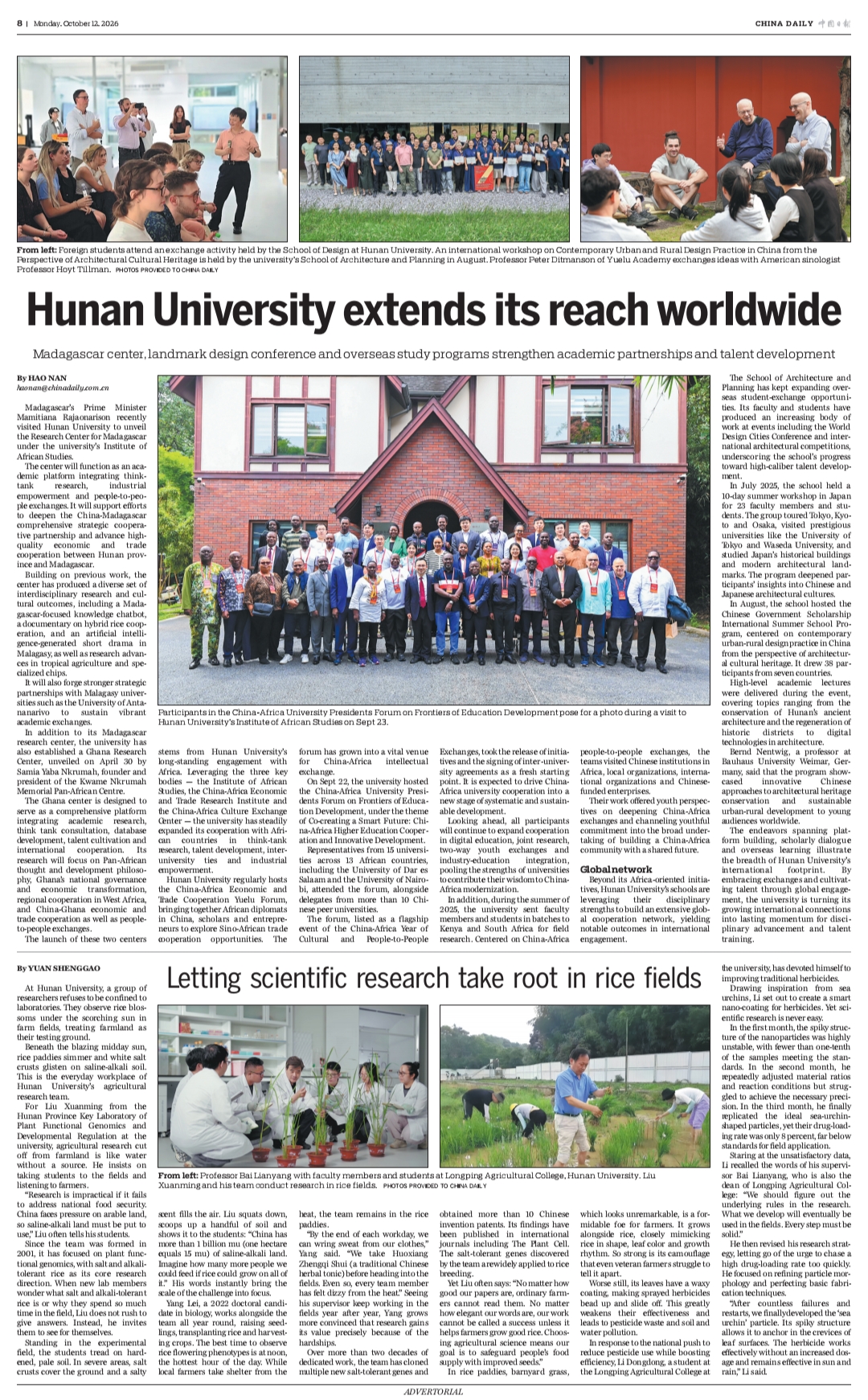
Foreign students attend an exchange activity held by the School of Design at Hunan University. CHINA DAILY
Madagascar's Prime Minister Mamitiana Rajaonarison recently visited Hunan University to unveil the Research Center for Madagascar under the university's Institute of African Studies.
The center will function as an academic platform integrating think-tank research, industrial empowerment and people-to-people exchanges. It will support efforts to deepen the China-Madagascar comprehensive strategic cooperative partnership and advance high-quality economic and trade cooperation between Hunan province and Madagascar.
Building on previous work, the center has produced a diverse set of interdisciplinary research and cultural outcomes, including a Madagascar-focused knowledge chatbot, a documentary on hybrid rice cooperation, and an artificial intelligence-generated short drama in Malagasy, as well as research advances in tropical agriculture and specialized chips.
It will also forge stronger strategic partnerships with Malagasy universities such as the University of Antananarivo to sustain vibrant academic exchanges.
In addition to its Madagascar research center, the university has also established a Ghana Research Center, unveiled on April 30 by Samia Yaba Nkrumah, founder and president of the Kwame Nkrumah Memorial Pan-African Centre.
The Ghana center is designed to serve as a comprehensive platform integrating academic research, think tank consultation, database development, talent cultivation and international cooperation. Its research will focus on Pan-African thought and development philosophy, Ghana's national governance and economic transformation, regional cooperation in West Africa, and China-Ghana economic and trade cooperation as well as people-to-people exchanges.
The launch of these two centers stems from Hunan University's long-standing engagement with Africa. Leveraging the three key bodies — the Institute of African Studies, the China-Africa Economic and Trade Research Institute and the China-Africa Culture Exchange Center — the university has steadily expanded its cooperation with African countries in think-tank research, talent development, interuniversity ties and industrial empowerment.
Hunan University regularly hosts the China-Africa Economic and Trade Cooperation Yuelu Forum, bringing together African diplomats in China, scholars and entrepreneurs to explore Sino-African trade cooperation opportunities. The forum has grown into a vital venue for China-Africa intellectual exchange.
On Sept 22, the university hosted the China-Africa University Presidents Forum on Frontiers of Education Development, under the theme of Co-creating a Smart Future: China-Africa Higher Education Cooperation and Innovative Development.
Representatives from 15 universities across 13 African countries, including the University of Dar es Salaam and the University of Nairobi, attended the forum, alongside delegates from more than 10 Chinese peer universities.
The forum, listed as a flagship event of the China-Africa Year of Cultural and People-to-People Exchanges, took the release of initiatives and the signing of inter-university agreements as a fresh starting point. It is expected to drive China-Africa university cooperation into a new stage of systematic and sustainable development.
Looking ahead, all participants will continue to expand cooperation in digital education, joint research, two-way youth exchanges and industry-education integration, pooling the strengths of universities to contribute their wisdom to China-Africa modernization.
In addition, during the summer of 2025, the university sent faculty members and students in batches to Kenya and South Africa for field research. Centered on China-Africa people-to-people exchanges, the teams visited Chinese institutions in Africa, local organizations, international organizations and Chinese-funded enterprises.
Their work offered youth perspectives on deepening China-Africa exchanges and channeling youthful commitment into the broad undertaking of building a China-Africa community with a shared future.
Global network
Beyond its Africa-oriented initiatives, Hunan University's schools are leveraging their disciplinary strengths to build an extensive global cooperation network, yielding notable outcomes in international engagement.
The School of Architecture and Planning has kept expanding overseas student-exchange opportunities. Its faculty and students have produced an increasing body of work at events including the World Design Cities Conference and international architectural competitions, underscoring the school's progress toward high-caliber talent development.
In July 2025, the school held a 10-day summer workshop in Japan for 23 faculty members and students. The group toured Tokyo, Kyoto and Osaka, visited prestigious universities like the University of Tokyo and Waseda University, and studied Japan's historical buildings and modern architectural landmarks. The program deepened participants' insights into Chinese and Japanese architectural cultures.
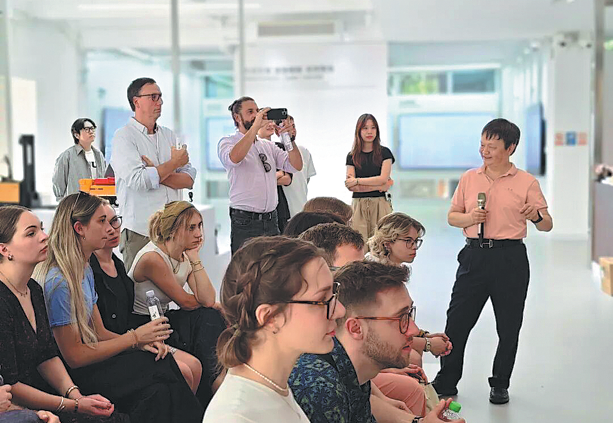
In August, the school hosted the Chinese Government Scholarship International Summer School Program, centered on contemporary urban-rural design practice in China from the perspective of architectural cultural heritage. It drew 38 participants from seven countries.
High-level academic lectures were delivered during the event, covering topics ranging from the conservation of Hunan's ancient architecture and the regeneration of historic districts to digital technologies in architecture.
Bernd Nentwig, a professor at Bauhaus University Weimar, Germany, said that the program showcased innovative Chinese approaches to architectural heritage conservation and sustainable urban-rural development to young audiences worldwide.
The endeavors spanning platform building, scholarly dialogue and overseas learning illustrate the breadth of Hunan University's international footprint. By embracing exchanges and cultivating talent through global engagement, the university is turning its growing international connections into lasting momentum for disciplinary advancement and talent training.
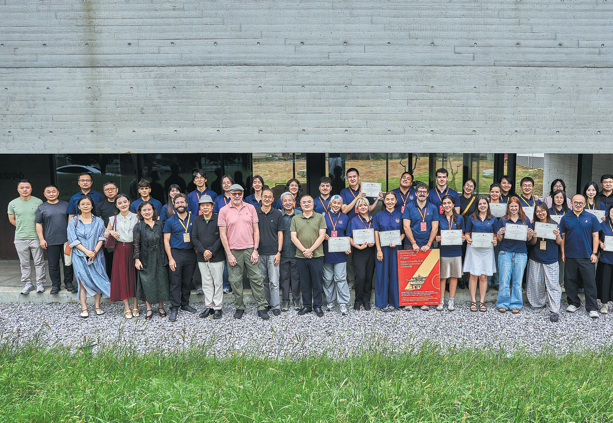
An international workshop on Contemporary Urban and Rural Design Practice in China from the Perspective of Architectural Cultural Heritage is held by the university's School of Architecture and Planning in August. CHINA DAILY
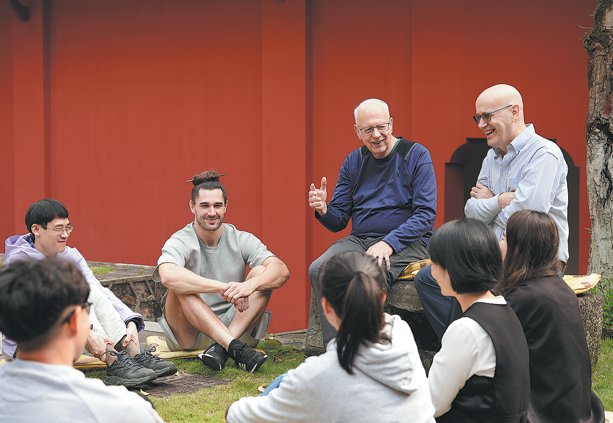
Professor Peter Ditmanson of Yuelu Academy exchanges ideas with American sinologist Professor Hoyt Tillman. CHINA DAILY

Participants in the China-Africa University Presidents Forum on Frontiers of Education Development pose for a photo during a visit to Hunan University's Institute of African Studies on Sept 23. CHINA DAILY
Letting scientific research take root in rice fields
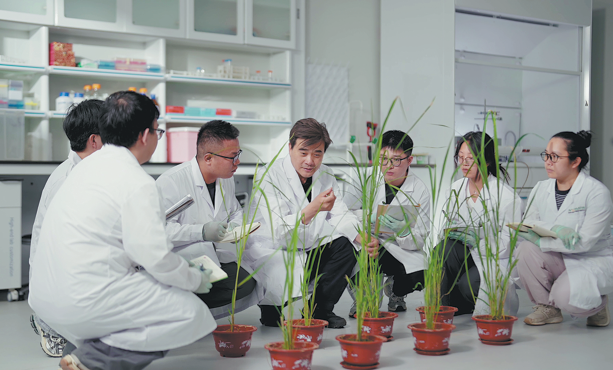
Professor Bai Lianyang with faculty members and students at Longping Agricultural College, Hunan University. CHINA DAILY
At Hunan University, a group of researchers refuses to be confined to laboratories. They observe rice blossoms under the scorching sun in farm fields, treating farmland as their testing ground.
Beneath the blazing midday sun, rice paddies simmer and white salt crusts glisten on saline-alkali soil. This is the everyday workplace of Hunan University's agricultural research team.
For Liu Xuanming from the Hunan Province Key Laboratory of Plant Functional Genomics and Developmental Regulation at the university, agricultural research cut off from farmland is like water without a source. He insists on taking students to the fields and listening to farmers.
"Research is impractical if it fails to address national food security. China faces pressure on arable land, so saline-alkali land must be put to use," Liu often tells his students.
Since the team was formed in 2001, it has focused on plant functional genomics, with salt and alkali-tolerant rice as its core research direction. When new lab members wonder what salt and alkali-tolerant rice is or why they spend so much time in the field, Liu does not rush to give answers. Instead, he invites them to see for themselves.
Standing in the experimental field, the students tread on hardened, pale soil. In severe areas, salt crusts cover the ground and a salty scent fills the air. Liu squats down, scoops up a handful of soil and shows it to the students: "China has more than 1 billion mu (one hectare equals 15 mu) of saline-alkali land. Imagine how many more people we could feed if rice could grow on all of it." His words instantly bring the scale of the challenge into focus.
Yang Lei, a 2022 doctoral candidate in biology, works alongside the team all year round, raising seedlings, transplanting rice and harvesting crops. The best time to observe rice flowering phenotypes is at noon, the hottest hour of the day. While local farmers take shelter from the heat, the team remains in the rice paddies.
"By the end of each workday, we can wring sweat from our clothes," Yang said. "We take Huoxiang Zhengqi Shui (a traditional Chinese herbal tonic) before heading into the fields. Even so, every team member has felt dizzy from the heat." Seeing his supervisor keep working in the fields year after year, Yang grows more convinced that research gains its value precisely because of the hardships.
Over more than two decades of dedicated work, the team has cloned multiple new salt-tolerant genes and obtained more than 10 Chinese invention patents. Its findings have been published in international journals including The Plant Cell. The salt-tolerant genes discovered by the team are widely applied to rice breeding.
Yet Liu often says: "No matter how good our papers are, ordinary farmers cannot read them. No matter how elegant our words are, our work cannot be called a success unless it helps farmers grow good rice. Choosing agricultural science means our goal is to safeguard people's food supply with improved seeds."
In rice paddies, barnyard grass, which looks unremarkable, is a formidable foe for farmers. It grows alongside rice, closely mimicking rice in shape, leaf color and growth rhythm. So strong is its camouflage that even veteran farmers struggle to tell it apart.
Worse still, its leaves have a waxy coating, making sprayed herbicides bead up and slide off. This greatly weakens their effectiveness and leads to pesticide waste and soil and water pollution.In response to the national push to reduce pesticide use while boosting efficiency, Li Dongdong, a student at the Longping Agricultural College at the university, has devoted himself to improving traditional herbicides.
Drawing inspiration from sea urchins, Li set out to create a smart nano-coating for herbicides. Yet scientific research is never easy.
In the first month, the spiky structure of the nanoparticles was highly unstable, with fewer than one-tenth of the samples meeting the standards. In the second month, he repeatedly adjusted material ratios and reaction conditions but struggled to achieve the necessary precision. In the third month, he finally replicated the ideal sea-urchin-shaped particles, yet their drug-loading rate was only 8 percent, far below standards for field application.
Staring at the unsatisfactory data, Li recalled the words of his supervisor Bai Lianyang, who is also the dean of Longping Agricultural College: "We should figure out the underlying rules in the research. What we develop will eventually be used in the fields. Every step must be solid."
He then revised his research strategy, letting go of the urge to chase a high drug-loading rate too quickly. He focused on refining particle morphology and perfecting basic fabrication techniques.
"After countless failures and restarts, we finally developed the 'sea urchin' particle. Its spiky structure allows it to anchor in the crevices of leaf surfaces. The herbicide works effectively without an increased dosage and remains effective in sun and rain," Li said.
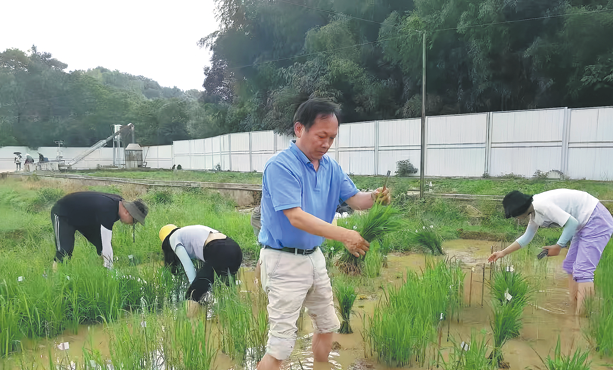
Liu Xuanming and his team conduct research in rice fields. CHINA DAILY