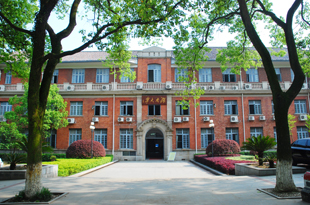
Hunan University (HNU) is a national key university directly under the Ministry of Education. It has been included in the national "Project 211" and "Project 985," and shortlisted for China's construction plan of world-class universities and first-class disciplines ("Double First-Class University" initiative)."
HNU traces its origins to Yuelu Academy, which was founded in 976 AD. In 1903, Yuelu Academy merged with the Hunan Institute of Higher Learning, which can be traced back to Shiwu School established in 1897, and then was officially renamed Hunan University in 1926. In 1937, HNU was designated as one of the 16 state universities. After the founding of the People's Republic of China in 1949, Li Da, one of the major founders and early leaders of the Communist Party of China, was appointed as the first president of HNU. Late Chairman Mao Zedong inscribed the name of the university. In 2000, HNU and the Hunan Institute of Finance and Economics merged to form the HNU of today. On September 17, 2020, Chinese President Xi Jinping inspected HNU, speaking highly of personnel cultivation and cultural inheritance of the university. He put forward that Yuelu Academy is the origin of the ideological line "Seeking Truth from Facts" of the Party.
Carrying forward the celebrated traditions of quality education and personnel cultivation, HNU has been continuing the essence of the motto "seeking truth from facts, and daring to be pioneers" and the spirit of "to be profound, intelligent, diligent, and dedicated in the pursuit of knowledge". A number of celebrities who had made tremendous and historical contributions in Chinese history were fostered, including Wang Fuzhi, Tao Shu, Wei Yuan, He Changling, Zeng Guofan, Zuo Zongtang, Guo Songtao, Tan Sitong, Huang Xing, Cai E, Yang Changji, Mao Zedong, He Shuheng, Cai Hesen, Deng Zhongxia, and Li Da. Forty-six faculty and alumni members have been elected as members of the Chinese Academy of Social Sciences the Chinese Academy of Sciences and academicians of the Chinese Academy of Sciences and the Chinese Academy of Engineering. This achievement embodies the saying "the Kingdom of the Chu, the home of talents."
HNU has 37 educational and research institutions, providing academic subjects in 13 professional disciplines—philosophy, economics, law, education, literature, history, science, engineering, management, medicine, agronomy, arts, and interdiscipline. HNU offers 87 undergraduate programs, 40 first-level disciplines authorized to confer master's degrees, and 36 first-level disciplines to confer doctorates. Chemistry, mechanical engineering, and electric engineering are listed as "world-class disciplines" of the Ministry of Education. The Marxism School has been recognized as a national key school of Marxism. Five disciplines rank among the ESI global top 1‰, while engineering discipline among the global top 1‱. In 2025, HNU ranked 43rd globally in the Nature Index ranking.
HNU has set its goal for talent cultivation, aiming to foster pragmatic future leaders in the new era. The full-time students total more than 41,000, of which over 23,000 are undergraduates, and 17,000 are postgraduates. HNU has two 2.0 bases of the Ministry of Education for top-notch student cultivation programs in basic disciplines and four national experiment and teaching demonstration centers. HNU won 16 National Teaching Achievement Awards in 2022, tying for 4th place nationwide. It obtained four national awards for teaching materials construction. HNU has been included in the national "101" Plan in chemistry, computer, and artificial intelligence, and designated by the Ministry of Education as a higher-education teaching material system construction team in the emerging expertise areas of strategic significance during the 14th Five-Year Plan period. It has been approved as a pilot involved in the national plan for strengthening basic academic disciplines, selected as a university to establish the National Graduate College for Elite Engineers, included in the "National Excellence Program", and authorized to develop one of the first batch of the national-level specialized and demonstration colleges of software and the national first-class school of cyber science and technology. Fifty-four undergraduate programs were designated as national first-class undergraduate programs and 94 undergraduate courses were selected as national first-class undergraduate courses. HNU has been recognized as one of the first batch of the candidates for developing the national schools of innovation and entrepreneurship, and China's first batch of demonstration universities for innovation and entrepreneurship education reform. Over the past five years, HNU students have won 16 national gold awards in the "China International College Students' Innovation Competition", "Challenge Cup" and other entrepreneurship and innovation competitions. HNU has established cooperation relationships with over 200 overseas universities and institutions, such as the University of California, Berkeley, and Nanyang Technological University.
HNU has a staff of more than 4,270, of whom over 2,393 are full-time teachers. The HNU faculty has received 372 national high-level talent awards and 275 national awards for high-level young researchers, including six full-time memberships in the Chinese Academy of Sciences and the Chinese Academy of Engineering and five winners of the National Outstanding Teacher Award. HNU has seven innovative research groups supported by the Natural Science Foundation of China (NSFC), one inaugural philosophy and social science innovation team approved by the Ministry of Education, one innovative team recognized by the State Administration of Science, Technology and Industry for National Defence, 14 national-level teaching groups, and four candidates for the national Huang Danian-style Teacher Teams.
HNU has seven state key laboratories; two national engineering technology research centers; one state engineering research center; one state energy R&D and innovation platform; two national-level international cooperation bases; one laboratory in the key disciplines of national defense; one integrated platform for major sci-tech breakthroughs approved by the Ministry of Education; one philosophy and social science laboratory of the Ministry of Education; thirteen key laboratories and engineering research centers of the Ministry of Education; six discipline innovation and talent introduction bases in higher educational institutions under the Ministry of Education; and, one key laboratory of the Ministry of Culture and Tourism. Since 2019, HNU has chaired 12 research projects winning the national science and technology awards (won four national science and technology awards in 2024, including one first prize for technology innovation, with the number of awards ranking 7th among the first-class universities nationwide), and 23 projects being granted with the humanities and social sciences awards of the Ministry of Education (including one first prize). HNU researchers have developed a number of first-of-its-kind technologies, such as ultra-low frequency underwater acoustic radar technology and facilities, eddy current dampers, gas dynamic pressure bearing technology, large-scale permanent magnet wind turbines, and three-dimensional five-axis linkage laser processing equipment. HNU has a national-level science and technology park, and was approved by the Ministry of Education as one of the first batch of university bases for commercialization of research findings and transfer of technologies, and a national demonstration university of intellectual property. The National Supercomputing Center in Changsha, the third supercomputing center in China, is operated and managed by HNU. The new generation of supercomputer Tianhe reaches a computing performance at world-class and domestically-leading level.
HNU currently consists of two campuses—the South Campus and the Caiyuan Campus, occupying a total area of 1.5433 million square meters. A new campus, the Kechuanggang Campus is under construction, spanning about 1.067 million square meters. The first phase of this new campus is planned to be put into use in 2026 when HNU celebrates the 100th anniversary of its official naming. The inauguration of the new campus is expected to provide strong momentum for HNU's high-quality development.
In the new stage of development, HNU will firmly follow the guidance of Xi Jinping Thought on Socialism with Chinese Characteristics for a New Era, remain committed to grounding its efforts in the Chinese context, and steadfastly pursues its world-class ambitions. It is dedicated to building itself into a world-class university with Chinese characteristics and rich in historical and cultural heritage, as early as possible, and striving to nurture socialist builders and successors capable of shouldering mission of national rejuvenation.
(Update: January, 2026)
Address: Lushan Road (S), Yuelu District,
Changsha, Hunan Province
Zip Code: 410082
Email: xiaoban@hnu.cn
Copyright © 1996-2010 All Rights Reserved by Hunan University 湘ICP备05000239号、09007699号、05016764号
If you come across any errors on our website or you have suggestions for the improvement of the website, please feel free to contact us at hnu976@hnu.edu.cn